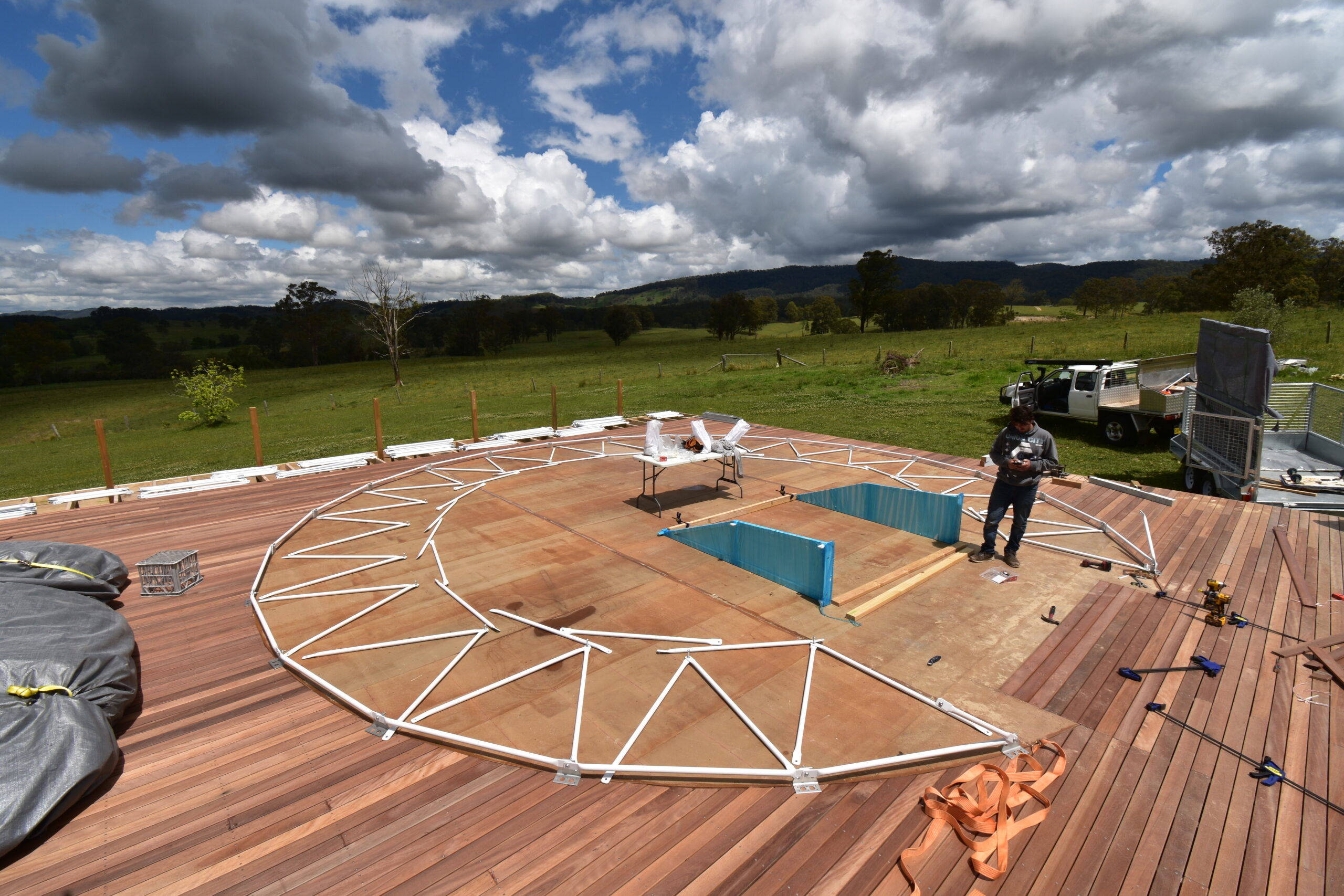
Build your foundation
When installing our Domes, there are two main foundation options to choose from: elevated deck or concrete base.
Both have their pros and cons, and the decision depends on several factors: cost, time, terrain conditions, maintenance, utility connections, and local regulatory requirements.
In this guide, we’ll walk you through the key considerations and raise questions that will help you make the right choice.
What kinds of costs?
Decking
Building an elevated deck is typically more expensive than a concrete base, especially if it’s made from high-quality materials such as hardwood, composite, or pressure-treated pine. Labor costs can also be higher.
It’s important to note that decks require ongoing maintenance, including surface treatments and staining.
From both a safety and comfort perspective, railings and stairs are often necessary, along with structural reinforcements—particularly if the deck sits significantly above ground level.
Slab
A concrete base is generally more affordable, though the cost can increase significantly if site leveling, drainage systems, or retaining walls are required.
Also consider how the concrete will be delivered—if a concrete mixer is involved, site accessibility becomes a critical factor.
How much time?
Decking
A wooden deck is generally quicker to construct, as it requires less groundwork and the building process is simpler overall.
Some time-consuming elements—such as the roof structure (e.g., pergola), surface treatment, or preparing the dome base—may take longer. We cover these in a separate section.
Slab
Installing a concrete base takes more time, as it involves:
● earthworks,
● formwork installation,
● reinforcement (rebar),
● pouring the concrete,
● and waiting for it to cure properly.
Additionally, you’ll need to factor in the time required to install utilities (water, electricity, gas), as well as to ensure proper drainage and potentially build retaining walls.
Utility Installation – Which Is Simpler?
Decking
Installing utilities (water, electricity, gas) is generally easier under an elevated structure, as there is sufficient space for routing and accessing pipes and cables.
Future upgrades—like adding air conditioning six months later—are also simpler to carry out.
Slab
Concrete provides a solid and durable foundation, but it requires all utility lines to be planned and installed before the concrete is poured.
Once the base is set, modifying or adding new lines becomes very difficult or even impossible.
TIP: Carefully plan your floor layout and any long-term improvements before pouring the concrete.
General Maintenance?
Decking
Wooden decks require more upkeep. Regular cleaning, staining, and surface treatments are necessary to protect against moisture, mold, and pests.
The level of maintenance depends on the materials used—steel frames and composite decking can significantly reduce the long-term workload.
Slab
Concrete needs less maintenance. It’s easy to clean and doesn’t require painting or surface treatment.
Over time, small hairline cracks may appear, but these are usually simple to repair.
Terrain and location?
Decking
An elevated deck is much more flexible for steep or uneven terrain, as well as hard-to-access locations.
It’s also more environmentally friendly and allows for more striking placement—like orienting the dome for a great view.
Slab
A concrete slab is ideal for flat or gently sloping areas, providing a stable and level foundation.
On steep or rocky terrain, construction becomes more complicated, requiring extensive earthworks, retaining walls, and effective drainage.
The soil type (clay, rocky, etc.) also affects the difficulty of machine work.
Regulatory Requirements – What to Consider?
Decking and Slab
Both Elevated Deck and Concrete Base:
Regardless of the type of foundation you choose, it’s important to check local municipal regulations beforehand.
Some municipalities or regions offer exemptions for smaller, temporary structures (e.g., platforms, tents, lightweight constructions), while in other areas even the foundation may require a permit.
Many of our clients consider our domes as:
- temporary structures,
- movable living units,
- premium tents (essentially semi-permanent, high-quality glamping tents).
Many do not officially register these, thinking: “I have the right to pitch a tent on my own land.”
Why do we share this? Just to let you know the common practice. Still, we encourage everyone—even if not for commercial use—to file a general notification about dome installation with their local municipality.
However, if you want an operating license to use the dome as accommodation, notification is mandatory. Without it, the dome cannot be legally rented out for overnight stays, and thus would operate illegally.
Whichever solution you choose, we provide a detailed installation guide to help you through every step of the process.
No matter what you chose, we will assist you with a guide
If you chose Slab
Discover more about slab options and installation.
Explore SlabIf you chose Decking
Discover more about decking options and installation.
Explore DeckingNext steps
Continue to the next step, or go back.
 EN
EN  HU
HU